
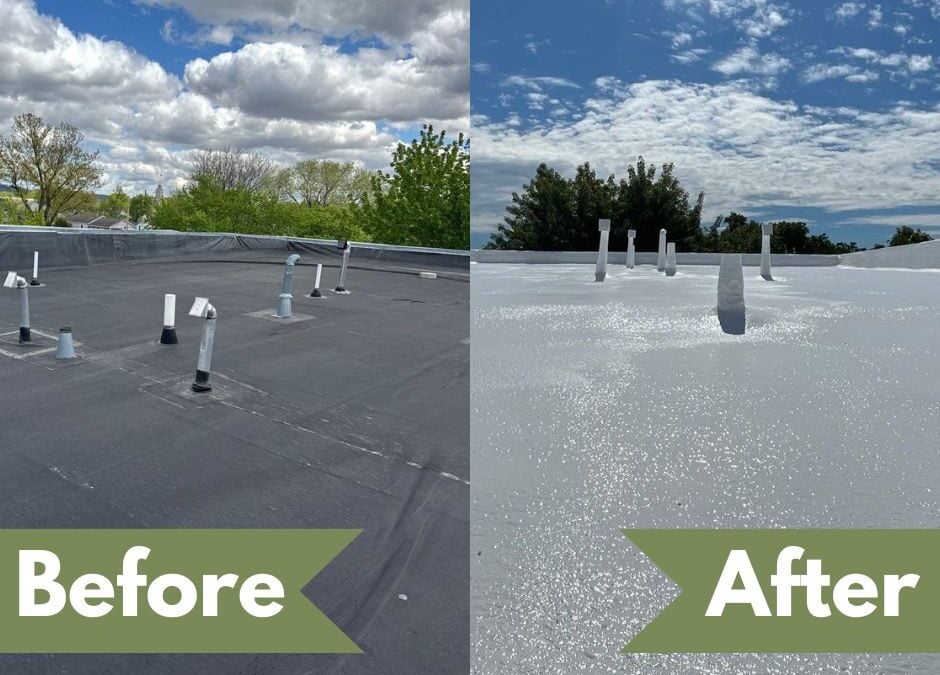
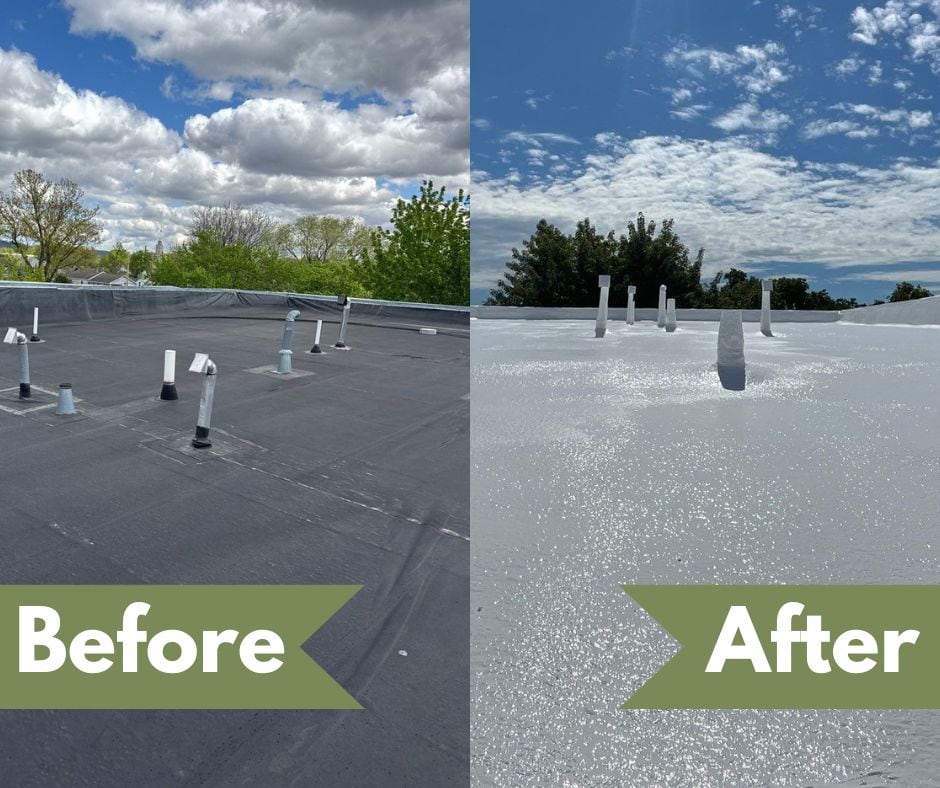
Before and after of a roof we spray foamed in Winona, MN.
If your commercial roof is leaking, aging, or deteriorating, you are probably considering replacing your roof, but another option is a roof restoration.
This decision affects more than just your budget — it affects your building’s downtime, energy use, and how much disruption your business has to handle.
Quick Summary
Commercial roof restoration is often the better option when the existing roof is still structurally sound, because it costs less, creates less disruption, and can extend roof life by 20 years or more.
Restoration systems can also help lower energy costs by improving insulation (via spray foam) & reflecting UV rays (via white topcoat).
Restoration vs. Replacement: The Core Difference
The biggest difference between restoration and replacement is what happens to the existing roof. Restoration keeps the current roof in place, repairs weak points, and adds a protective new system over the top.
Replacement removes the old roof and installs a new one, which usually means more labor, more materials, more equipment, and more downtime.
For many building owners, that extra disruption is a significant cost that gets overlooked. If your building is occupied, customer-facing, or sensitive to noise and fumes, restoration may be a more practical choice.
How Much Does Each Option Cost?
Commercial roof restoration in Minnesota, Wisconsin, and Iowa range from $3.50 to $9 per square foot, depending on the roof system, the condition of the roof, and whether tear-off is required first.
Metal roof restoration and flat roof restoration are $3.50 to $5.50 per square foot, while spray foam restoration are $6.50 to $9 per square foot.
By contrast, metal roof replacement is $10 to $18 per square foot, and rubber roof replacement is $6 to $12 per square foot.
Restoration typically costs significantly less while still delivering a long service life and strong warranty coverage.
Which Project Disrupts Your Business Most?
#1 Metal Roof Replacement
A metal roof replacement brings heavy noise from drills, power tools, and hammers, plus delivery trucks, cranes, and large staging areas that can take over parking or loading zones. In some buildings, vibration from the work may shake loose dust or ceiling tiles inside.
This kind of project is often a poor fit for offices, hotels, retail locations, and other properties where quiet and customer experience matter or municipal buildings which need to remain operational while the roof is installed.
#2 Rubber Roof Installation
Rubber roof replacement is usually less noisy than metal, but it still creates noticeable disruption. Tear-off, drilling, heavy foot traffic, dumpsters, and staging areas for the rubber all affect the site, and fully adhered systems (that use molten tar for example) can also create strong odors.
That makes rubber roofs a tougher option for restaurants, clinics, schools, and other buildings where indoor air quality matters.
#3 Spray-On Restoration
The loudest part of a roof restoration is usually pressure washing. After that the system is applied with spray equipment or rollers without major tear-off, drilling, or structural noise. It also requires far less staging space and produces little to no debris.
The main operational concern is overspray management, so crews may need to move vehicles and watch wind conditions during application.
Why Does Restoration Cost Less?
Restoration avoids the biggest cost drivers in commercial roofing: tear-off, dumpster fees, disposal, new materials, and the extra labor required for a full replacement. When the existing roof stays in place, the project usually moves faster and creates less interruption for the building occupants and requires smaller crews.
That efficiency is one reason restoration works so well for occupied commercial buildings. It lets owners fix leaks, improve performance, and protect the structure without turning the property into a construction site for a couple weeks.
What Affects the Final Price?
Generally for roofs (restorations and replacements alike), the main price factors are the number of roof penetrations, material, and accessibility.
Roof penetrations are a big one because HVAC units, skylights, drains, and pipes all require custom flashing and sealing and (for rubber or metal roofs) custom cutting of the material to fit around the penetrations.
Material choices also matter. White rubber roofing can cost more than black rubber roofing, and copper metal can be dramatically more expensive than steel.
Accessibility is another major variable, especially on high-rise buildings or properties with tight access that require cranes or specialized equipment.
Lifespan and Warranty
Metal roofs last for 30-40 years, rubber for 20-30 years and restorations for 20-25 years.
20 year warranties are standard for most roofs (metal, rubber, & restorations).
But warranty language matters too. Some companies advertise a roof price and then add separate fees for the warranty package, so it is important to ask exactly what is included before you sign.
Best Uses By Building Type
Restoration is usually the best fit when the roof is still structurally sound but showing signs of aging, leaks, or worn seams. It is especially useful for building owners who want to improve insulation (with spray foam + white topcoat), reduce energy loss (with spray foam), and avoid major disruption.
Replacement is usually the better option when the roof is beyond saving or the existing structure has deeper problems that coatings cannot solve. In those cases, restoration may not be enough to protect the building long term unless spray foam is used as well.
Businesses in Wisconsin, Minnesota, & Iowa
Commercial roof restoration is a strong option for businesses in Wisconsin, Minnesota, & Iowa because we’re here!
But also restoration fixes two big issues at once: roof damage and energy loss.
For businesses within a three-hour drive of Sparta, WI, we are happy to do no-obligation roof inspection and answer all your questions.
FAQ
Can every roof be restored?
No. The roof must be in good enough structural condition to support a restoration system. A professional inspection is the only reliable way to know whether restoration is realistic.
Does restoration help with energy bills?
Yes, especially with spray foam roofing and white reflective coatings. Spray foam can reduce energy bills by up to 30%, and the white topcoat can reduce roof temperatures by 50 degrees in the summer.
How long does a restored roof last?
Many restoration systems last 20+ years, depending on the roof type, product used, and maintenance.
Is restoration always cheaper than replacement?
No — some rubber roofs are cheaper than roof restorations.
Final Recommendation
For most commercial buildings, restoration is the smart first conversation because it can lower cost, reduce disruption, and improve roof performance without immediately jumping to a full tear-off.
Replacement still has its place, but it should be chosen because the roof truly needs it, not because it is seems to be the only option.
Need help determining whether your roof can be restored? Contact SR Commercial Roofing for a free inspection at (608) 844-4933.
